

Platform Tennis Index
What is PTI?
Platform Tennis Index (PTI) is a performance rating developed by the APTA. PTI is an objective data driven measure of rated match performance. Using this rating, league administrators and tournament directors are able to organize competitive play amongst players of similar performance levels.
August 2026 Update
The APTA’s PTI Algo Committee has rolled out an updated version of the PTI Algo. The updated algo is less of a change vs the last update (PTI 2.0) two seasons ago (which was more of a complete overhaul, different math, etc). This current update incorporates several tweaks to the previous algo which we believe improve upon the current algo which is functioning very well. While it’s not the reason we are making these tweaks to the algo, the tweaks do have the added benefit of improving both the short-term and long-term (predictive) accuracy of the PTI algo.
Newest (2026) updates to the PTI Algo
Simplification of PTI Rating composition: previously, PTI incorporated both measures of performance and rating confidence. With the latest update, PTI now exclusively expresses the current performance component. This eliminates the rare situations where rating uncertainty could cause a player rating to worsen despite having won a match in straight sets.
Improvements to Rating Confidence: some fine tuning to how rating confidence/variance works which should mean slightly smaller match to match adjustments for more established players and responsiveness for players with inaccurate ratings.
Time Decay: player rating confidence will decrease with absence from rated play. Players with longer absences will tend to adjust more quickly than players with recent matches. Additionally, partners/opponents of players with stale ratings will have adjustments muted
Improved StartBot: StartBot is the feature in the algo which automatically and retroactively adjusts a player’s start rating based on the results of the player’s first set of matches when those results suggest their initial start rating was not accurate. You’ll recall this enhancement eliminated 99% of the manual intervention required prior to PTI2 when we had inaccurate start ratings. This new enhancement makes StartBot a little more aggressive in the adjustments and will make it more likely that start ratings will be automatically adjusted. Additional heuristics have been added reflecting that new players are more likely to get better vs worse in their first rated matches. This enhancement to StartBot will have virtually no impact on players who already have a lot of match history. It will also make the default start ratings that leagues have set up a little less important as StartBot will be more active adjusting new players
PTI Description
What’s the best way to view my PTI History (for leagues which display PTI)?
How to see your PTI history
What is a PTI?
PTI stands for Platform Tennis Index. It’s a rating system developed by APTA volunteers to rate the skill level of a player based on results from match data.
What does my PTI mean?
A player’s PTI is a number generally ranging from 0 to 100. Similar to a golf handicap, better players have a lower PTI.
- An 80+ rating is often associated with new players who likely have limited experience playing other racquet sports, or more experienced players whose mobility or athleticism have deteriorated.
- A 0 (or better) tends to be found amongst highly skilled athletes who can compete at the very top national level.
- Players who play in isolated pools of players or who play in consistent mismatches may find themselves over or underrated relative to the larger national playing pool
- The average PTI for league players is in the 50-60 range; slightly lower for men, slightly higher for women
- While it’s possible to have a negative rating, less than 1% the roughly 50,000 players rated currently have a negative rating
How do players get an initial PTI?
There are several options to set a player’s initial Rating:
- Use a default PTI based on a player’s division/line number for his/her first league match
- Have a pro or team captain assign an initial PTI (done through league commissioner)
- If a player’s first match isn’t a league match (ie; tournament, casual, box) and they haven’t been assigned a rating manually, they will be either be assigned an average PTI based on gender or will be manually assigned a rating based on the results of their first matches
Once a player has been assigned a start rating, their play will be algorithmically monitored through their first few matches. If a player performs significantly worse or better than expected, their start rating may be automatically adjusted.
How do PTIs adjust?
PTIs are dynamic, and adjust after match results are posted. The PTI algorithm uses the match outcome and the relative strength of the teams to determine the adjustment.
- Your PTI gets better when you win a set and gets worse when you lose a set. The score of the set impacts the magnitude of the move
- With the new PTI algo, for example, if you win in straight sets, your rating cannot get worse, regardless of set score or rating differential
- Conversely, significant underdogs who win a set may improve their rating for that, whereas in the past they did not
- Percent of games won still impacts ratings adjustments, but only in the magnitude of the rating change. Winning a set 7-6 will not result in the same rating change as 6-0.
- All matches count, no matter the difference between teams
- The original algorithm would skip matches with a ratings difference of greater than 20, unless an upset happened. These matches now count (though they don’t move the needle too much)
- The new PTI algo weights all sets and matches the same;
- It eliminates the match scaling we had with the original algo where main draw tournament matches count more… or casual matches count less
- The math for the new PTI algo is complex.
- While it will be very difficult for most of us to follow the exact details of the algo, we are creating a calculator that allows you to plug in player PTIs and a match score to see how the algo adjusts. Calculator link
- The new PTI algo almost entirely eliminates the need for manual adjustments:
- The new algo automatically adjusts a new player’s Start Rating after a handful of matches if a certain threshold of PTI movement is hit
- The new algo has a much more dynamic and complex version of the original algo’s confidence factor… which eliminates any need for manual adjustments of established players
- Ratings moves after each match may not be the same for every player on the court.
- This is due to a factor that the newer algo accounts for whereas the original algo did not: volatility of performance by each individual player (tentatively called Sigma at this time). The higher the volatility of a player’s performances, the larger their PTI move will be for any given match. This factor is assumed to be relatively high at the beginning of a player’s recorded career which is why the new algo is able to move PTIs much more quickly for over-performing or under-performing new players. Over the course of future matches, this volatility factor will lower to an equilibrium point around which it will tend to oscillate. However, this equilibrium point is different for each player. Thus, the amount one player’s PTI moves due to a given match can be different from the moves that the other players experience.
- The new algo will not allow for “Confidence Date” adjustments. Instead, the volatility factor (Sigma) is dynamic. It is sensitive to significant changes in player performance and will automatically rise when it measures a statistically significant change in volatility of performance, thus allowing their PTI to move more than previously.
For example: Player A (a 20 PTI) and Player B (28 PTI) have a match versus Player C (24 PTI) and Player D (30 PTI). Team A/B has a combined PTI of 48 vs. Team C/D’s of 54. Team A/B has a lower PTI and is favored to win the match.
If Team A/B wins, this is the expected outcome. PTIs for A and B will decline a small amount; PTIs for C and D will increase by the opposite amount.
On the other hand, if Team C/D wins, this is an upset! PTIs for C and D will decline by a more significant amount while PTIs for A and B increase.
Large changes in PTI are achieved through upsets or lopsided victories between closely-matched teams. A heavily-favored team cannot meaningfully improve its PTI by feasting on weak opponents.
In the event a player is believed to be mis-rated, what is the process for having that player adjusted?
With the move to the new algo, we have seen a dramatic reduction in the need to adjust any players’ ratings. There will be the very rare “outlier” where an adjustment may be necessary. The APTA is centralizing that rating adjustment process; leagues will no longer be making any adjustments locally. The APTA’s Algo Committee has created an email address, pti@platformtennis.org, that League heads can use to alert the Algo Committee about potential outlier ratings.
What exactly is PTI measuring? Is it like a golf handicap?
A golf handicap measures a golfer’s “potential” because it throws out your worst scores and takes an average of your best scores. Your PTI doesn’t measure your potential because it captures all your matches. It’s a measure of your actual performance/match results and not your potential.
Who is in charge of the PTI algorithm?
The APTA has a PTI Committee which monitors how the algo is working and reviews suggestions for tweaking the algo during the off-season.
How do Leagues use the PTI system?
There are no set standards for how a league could or should use the PTI system. Keeping in mind that PTI is a tool, each league should decide for itself whether and how to use PTIs. Some of the more common uses for PTIs include:
- Tournaments: PTIs are used to offer tournaments at different skill levels. A tournament director can set any eligibility threshold he or she wants for a tournament (an individual threshold, a combined/team threshold, etc). PTI are also being used to determine seeding and draw placements for tournaments.
- Teams: Captains and/or Pros use PTIs to help determine the appropriate teams for players within a club.
- Leagues: Leagues can use PTIs to help determine what division to place a new team in the league.
- Line-ups: PTIs can be used to prevent lineup “stacking”.
FAQs and Other common questions about individual PTIs
Where do we expect to see PTI “outliers” (ie; where are the edge cases where players may become temporarily mis-rated under the new algo)?
Unlike with the original algo, in the new algo there are no “skipped” matches. While heavy favorites can’t improve their PTI meaningfully by beating big underdogs… they also can’t ever see their PTI get worse if they win in straight sets.
The reverse of that is also true. Big underdogs cannot improve their PTI just by playing close sets vs heavy favorites. They need to win a set to improve their PTI
Therefore, it’s possible that there will be edge cases where players for a variety of reasons find themselves in divisions or on teams or spots in their line where they are always expected to win or lose. If/when that happens, we will likely see those players become overrated or underrated UNTIL they get to a division/team/line where they are more appropriately matched (at which point their PTI will quickly adjust back to a more accurate level
How much should my rating swing over the course of a season?
For players who have played enough matches to have a fairly accurate PTI (at least 7, but ideally more than 20), your PTI is likely to live in a band of 5-6 points. If you’re “true north” PTI is a 25, it’s very possible you could get as low as a 22 and as high as a 28 during the course of a season depending on partners you play with, opponents you face, tournaments you enter, etc. Please don’t get hung up on a couple point move here or there. It’s a doubles game so there will be times when you are probably underrated by your PTI; conversely, there will be times when you’re probably overrated vs your PTI. The algo is a self-correcting mechanism which will make it difficult to keep you from your “true north” PTI for too long.
How do third set superbreakers (in lieu of the third set being played out) get treated by PTI?
A third set superbreaker should be scored the same way it has been… 1-0 for the team that wins the tiebreaker. PTI will treat that set (regardless of the actual tiebreak score… 10-0, 10-8, etc,) as if the set score were 7-6.
Note: To reiterate, game score really only has an impact on the magnitude of “adjustment” made for winning/losing a set. This answer reflects that winning or losing a superbreaker is NOT a decisive result but rather a very close result. As such, a superbreaker has as low an impact as a 7-6
Where can I see my PTI?
PTIs will be displayed the same way they have been displayed in the past
- Many leagues have a Ratings tab on their league site that allows players to see detailed match and ratings history for everyone in the league
- Some leagues have opted to hide/suppress the ratings tab. For those leagues, a player can still see their own PTI by creating a profile on the site and logging in (PTI will be listed under the players “profile” link/page). Players will not be able to view anyone else’s PTI on that league site.
I have played most of my matches with the same partner; why did their new PTI improve while mine got worse (or didn’t improve by as much)?
Short answer: the difference will be in how you performed in the matches where you didn’t play together
Long answer: for two players with a fair amount of history, your ratings will move up and down together when you play together. They will only move independently when you play apart.
For the new PTIs, we have completely replaced the algorithm behind the ratings system in such a way that the calculations end up in the same number range. More simply, it’s brand new math that mostly agrees with the old math. This is great news because it provides further confidence that our old algorithm was pretty good, and that we have been able to improve on it.
The new algorithm is more sensitive to changes in match performance than our older algorithm and that accounts for the different handling of historical matches. We’re confident that this approach results in a statistically significant improvement in Predictive Accuracy of the system (% of matches in which the lower rated team wins).
If you are/remain confident that your rating relative to your partner’s is off, the easiest way to remedy that is to play rated matches with a different partner… or even better, play (and enter a casual match score) against your regular partner.
How do I enter a casual match score?
Video: Entering a Casual Match score
Why are PTIs not updating immediately when I post a score?
For the time being, PTIs are not updating “live” (as soon as scores are entered). PTIs will update overnight. So if your match score from last night’s league matches weren’t posted til the day after (or if a score has been edited), PTIs won’t update til the next morning
FAQs specific to the latest version of PTI (2026 updates)
What are some typical scenarios where PTI ratings calculated from the latest version of the algorithm differ more significantly from the previous version (PTI 2.0)?
A large percentage of the bigger moves in PTI ratings (e.g. at least 2 points) point back to how “Sigma” now typically evolves as a player accumulates more and more career matches. This is illustrated nicely by the following graph.
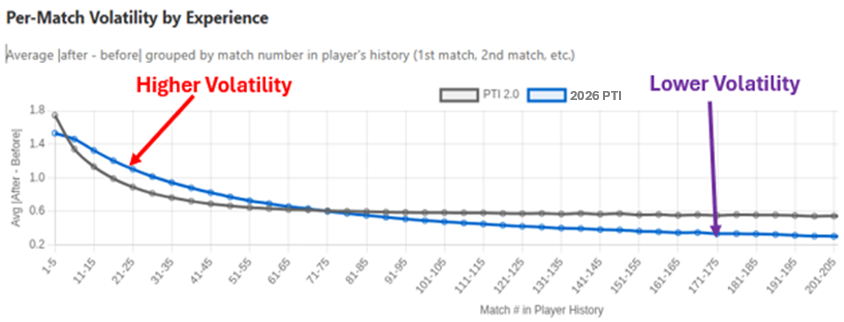
Observe that the graph shows that typical byproducts of the new algorithm are (1) notably larger movements per match (i.e. higher volatility) in career matches 10-50, and (2) significantly lower movement in a player’s rating once they get past their 100th career match or so. This phenomenon leads to these potential scenarios:
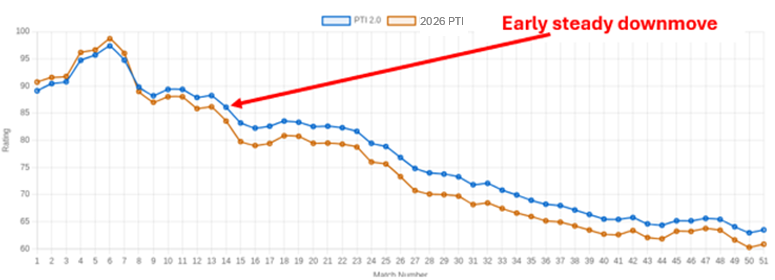
- Player has played around 20 to 60 career matches; player’s performance in those matches resulted in a pretty steady climb or drop in their rating (i.e. they tended to win or lose a vast majority of sets they played over that period of time). The result: Due to the new algorithm’s higher volatility of ratings at this point in a player’s career, each consistent move up or down in rating is now a bigger move, so players whose ratings consistently dropped over these matches will now drop even more. The opposite holds true for players whose ratings consistently moved up. See a graphic example below.
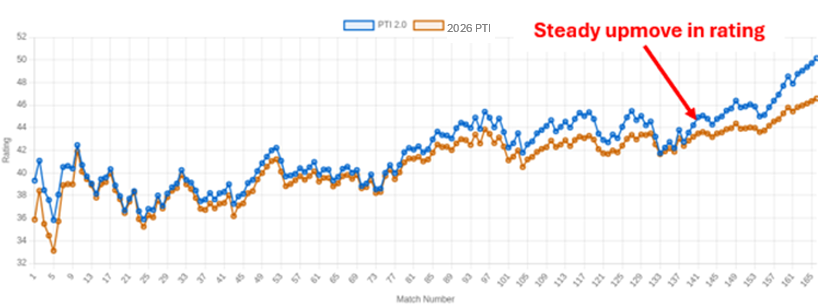
- Player has 150+ career matches; player’s most recent performance (i.e. their last 10-30 matches or so) resulted in their rating consistently moving up or down. The result: This is the flip-side of scenario (i) above. Because their Sigma, or volatility per match, is so much lower than it was in the previous algorithm, this “hot streak” or “cold streak” doesn’t impact their current PTI rating nearly as much as it used to. The recently under-performing player will see their current rating lower than it was before and the over-performing player will see it higher than before because of this phenomenon. Graphic example below:
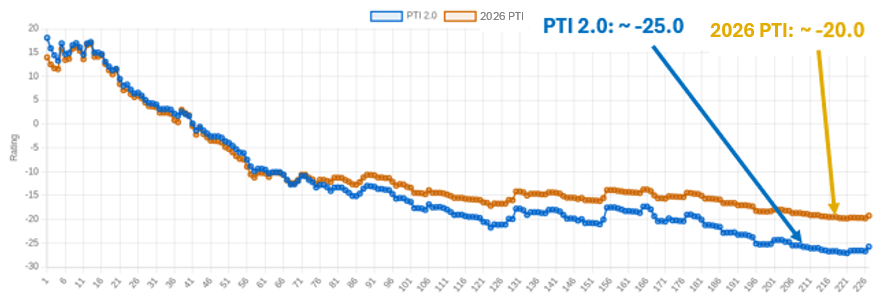
- Player is experienced and truly elite (top ~100 nationwide) The result: The player’s PTI will increase (get worse), though the player’s immediate peers will increase by a similar amount. The very best players will now be in the -10 to -20 range instead of the -15 to -25 range. This change promotes a healthier PTI range and more realistic ratings for elite players playing outside of a tournament context Example below:
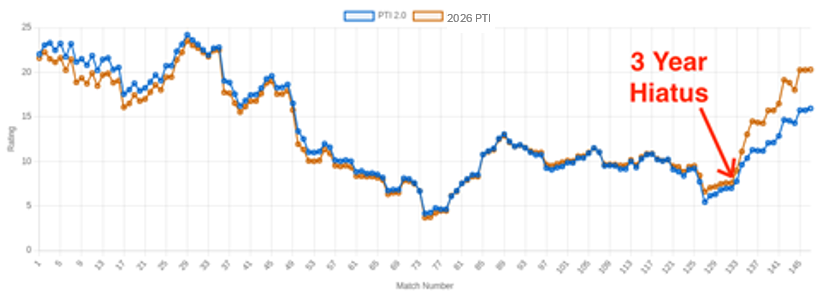
- Player had a point in their career when they had more than a year between rated matches. Because of this, their sigma now gets raised automatically which can substantially increase how much their rating can move per match. The result: If when the player comes back from their layoff they are playing at a notably higher or lower level, their rating will adjust to this much more quickly now under the new algorithm. Graphic example below:
Official APTA Sponsor
