


First in a series of articles and videos unraveling the mysteries of the Platform Tennis Index.
By Demian Johnston, the self-proclaimed “PTI Guy”
Every week a few emails land in the PTI Committee inbox that boil down to one question: “What does my number actually mean?” Fair enough. Most of us were handed a PTI the first time we stepped on a league court, and few of us got an explanation. So let’s start this series at the beginning.
Lower is better (and that’s where the golf comparison ends)
Your Platform Tennis Index is a number that generally runs from 0 to 100, and like a golf handicap, lower is better. That’s where the resemblance stops. A golf handicap throws out your worst rounds and averages your best ones, so it measures your potential. PTI counts every rated set you play, good nights and bad ones. It measures what actually happened on court.
Here’s where the 45,000 or so players active in the last two seasons sit today:
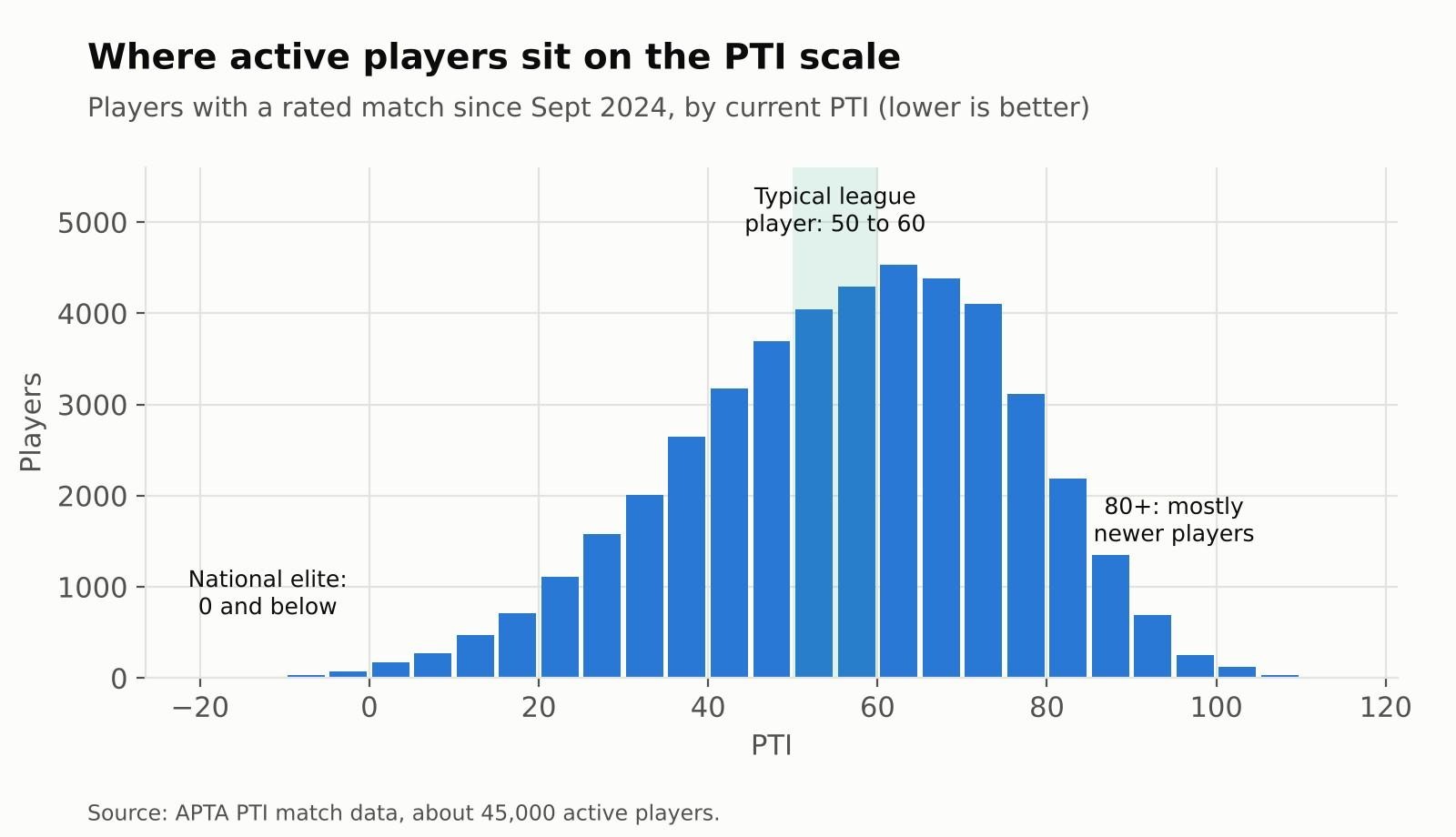
Most league players are rated between about 45 and 75. The national elite sit at 0 and below; players in the 80s and up are mostly newer to the game.
As the FAQ puts it, the average league player is in the 50 to 60 range, slightly lower for men and slightly higher for women. Fewer than 1% of rated players have a negative PTI.
What PTI is, and what it isn’t
I’ll say this one plainly, because it’s the thing I most want you to take away: PTI is not a measure of individual skills. It’s a statistical record of match performance. It sees four names and a score. It doesn’t see your gorgeous overhead, your partner’s bad back, or the wind. The website describes it as “an objective data driven measure of rated match performance,” and that’s exactly right.
Its job is simple: help league administrators, captains and tournament directors put players on court in matches that will be competitive. Everything else (bragging rights, flight debates, the group chat) is a side effect.
How it moves
PTI updates overnight after scores are posted, and it works set by set:
- Win a set and your rating improves. Lose one and it gets worse.
- The score sets the size. A 6-0 set moves things more than a 7-6.
- Before every set, PTI estimates which team should win from the four ratings. When the favorite wins, ratings barely move, because the result confirmed what the system already calculated. Upsets move them a lot.
The FAQ’s own example makes the point. Player A (a 20) and Player B (a 28) play C (a 24) and D (a 30). A and B have the lower combined total, so they’re favored.
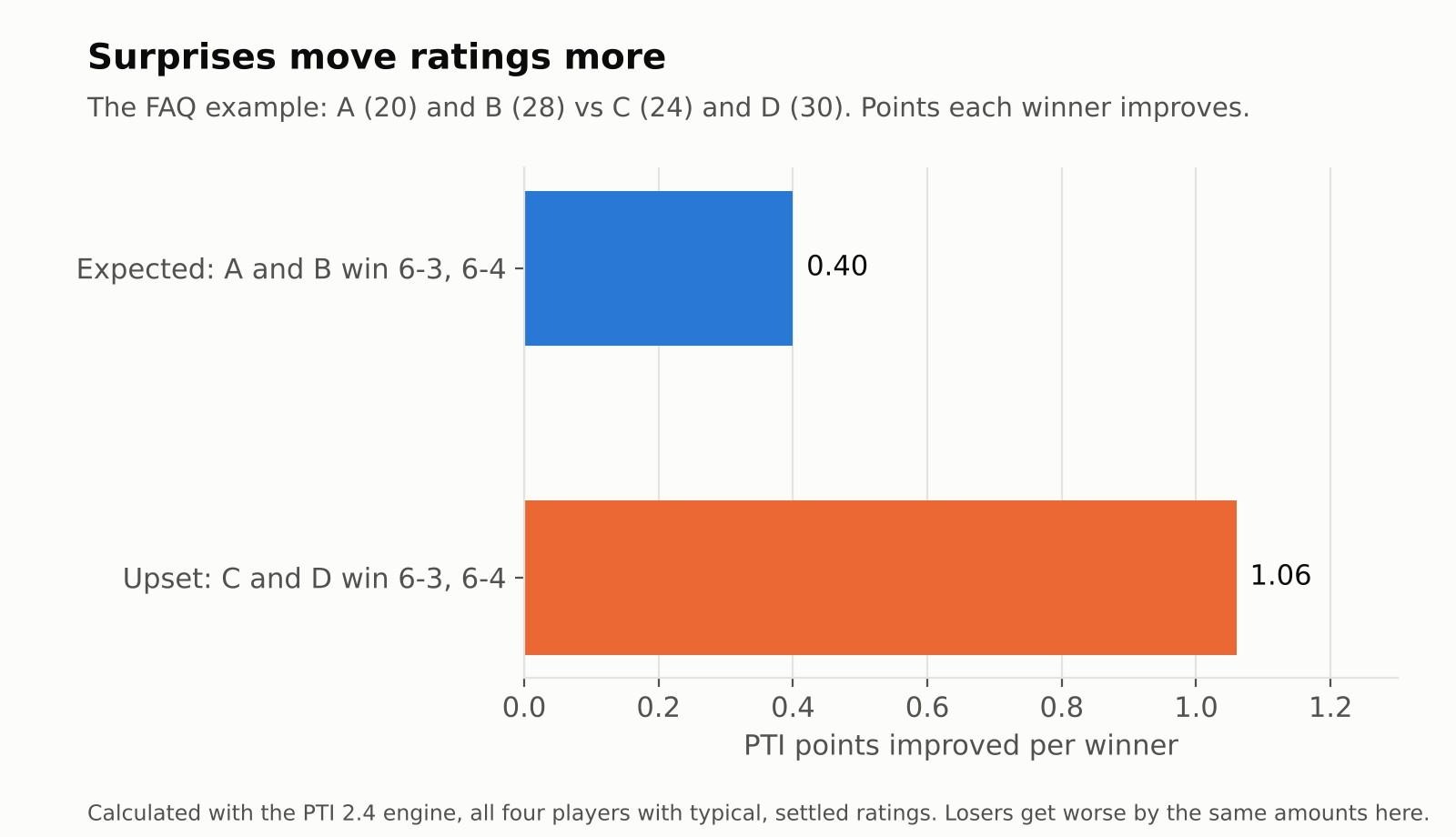
Same score, different story: the expected win moves each winner 0.40, the upset moves each winner 1.06.
That’s also why a heavy favorite can’t “feast” on weak opponents. Beating the team you’re supposed to beat earns very little. Win in straight sets and your rating can’t get worse, but it won’t improve much either.
Partners can move by different amounts
You’ll sometimes notice that you and your partner won the same match but moved by different amounts. That isn’t PTI deciding who played better. Each player has a hidden measure of how certain the system is about their rating, and less certain ratings move more. I’ll dig into that in a later article, “Credit Score.”
For the analytical nuts
PTI is a performance scale behind the scenes. Before each set, the expected chance that a team wins is a logistic curve on the difference between the two teams’ total performance, scaled by the combined uncertainty of all four players plus a fixed amount of randomness built into the sport.
After the set, each team’s rating moves by its share of the uncertainty, multiplied by how surprising the result was, multiplied by a factor for the game share (more lopsided sets move more). Rating set by set, rather than match by match, means a three-set match carries three pieces of evidence, not one.
In the example above, A and B’s combined performance edge gave them roughly a 70% chance of winning each set. Winning confirmed the expectation (a small move); losing contradicted it (a move about two and a half times bigger).
Where to go from here
If you want to see the math in action, plug any four ratings and a score into the PTI calculator. It uses typical values for each player, so treat the result as a good estimate. And the full PTI FAQ is always on the APTA site and under Info on your league website.
Get out on the courts, play to win, play with good sportsmanship, and most of all, have fun!
More in this series: It’s All Relative: Why the Number Itself Means Less Than You Think · Ride the Rollercoaster: The Signal in the Noise · Credit Score: What Sigma Is and Why Your Partner Moved More. PTI Guy’s articles and videos can be found here. The APTA will also be publishing the series this season.